Alumni Profile: Neuroscience nurse and app creator pays it forward for night shift workers
By Gianluca D'Elia
Tuesday, July 21, 2026
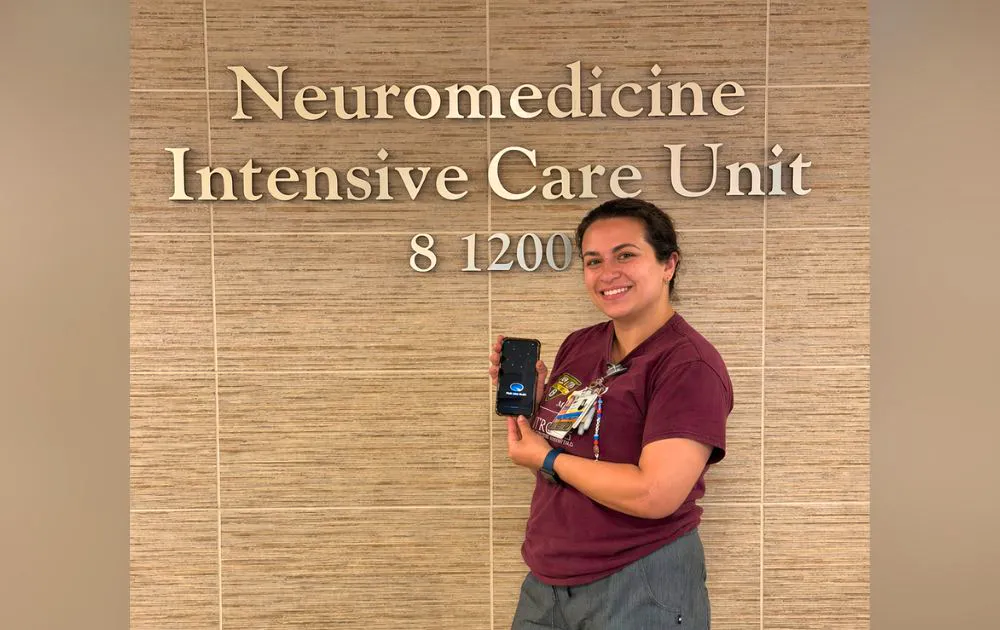
On her busiest night shifts at Strong Memorial Hospital, Caris Trippe ’21N, RN, has walked more than 12,000 steps. But at the end of each shift, on the way back to her car, she’d get a push notification she dreaded seeing: the health tracking apps on her phone and watch would tell her she had barely logged 5,000.
Seeking a way to get accurate metrics and stay on top of her wellness goals while working a unique schedule, Trippe created a solution: an app called Night Shift Mode. The app lets individuals who work overnight track metrics such as steps, calories, and sleeps without their devices resetting at midnight.
“There’s so much research out there about how night shifts can be detrimental to your health — and it’s scary, because someone has to do it. That led me to think about how I can make it healthier for people,” said Trippe, who works in Strong Memorial Hospital’s neuromedicine intensive care unit (8-1200).
“Having more accurate health tracking can help you decide how your day goes and be more mindful. For example, if I’m thinking, ‘Why don’t I go to bed until 10 a.m. after I work nights?’ I can focus on how to calm my brain down and relax. Having those health insights can bring to your attention where you're lacking, and make working a night shift a little bit healthier,” Trippe explained.
Trippe is excited by the opportunity to support nurses’ health and wellness, especially recent nursing school graduates who may find themselves working nights. Prior to pursuing the University of Rochester School of Nursing & Health Sciences’ 12-month bachelor’s, she worked in emergency medical services (EMS) and was accustomed to working overnight. But for many of her classmates and co-workers, it was a new experience.
She hopes Night Shift Mode will not only be useful to nurses, but to others who work overnight shifts, such as first-responders and factory workers. The significance of the app being founded and led by a registered nurse and former EMT isn’t lost on her.
“The biggest part about Night Shift Mode being nurse-owned is that I understand how night shifts are, and how they can make you feel, so this comes from a place of wanting to genuinely help, rather than make money,” Trippe said.
Q: What was the best part of your URochester experience?
Balancing a mix of remote and in-person learning as she pursued her degree during the COVID-19 pandemic, Trippe was grateful for the opportunity to see patients and learn at the bedside, and to develop friendships with her classmates throughout her clinical experiences.
“People will tell you that nursing school teaches you how to pass the test — and that part is true, but the University of Rochester School of Nursing & Health Sciences set me up with great skills to start. As daunting as starting in the ICU as a new grad can be, I felt that I was well-prepared.”
A solid foundation from the School and her orientation and continued training with URochester Medicine Nursing Practice have helped Trippe expand her role to serve as a preceptor, charge nurse, and alert nurse.
Q: Tell us about your role as a preceptor.
“I learned a lot and became much more confident in my own skills,” Trippe said, recalling her first time working with a newly hired orientee. “It helped me get used to talking through what I’m doing and breaking things down step by step, and it helped me stay calm under pressure.”
Thinking back to her own training, Trippe holds a deeper appreciation for the work that goes into preparing new nurses.
Q: What advice would you share with students or recent graduates?
Trippe often tells new graduates working in the ICU, “I’m so glad you’re here,” and that “this is hard, but you’re going to make it.”
“My advice to new graduates would be to push yourself. If you’re thinking, ‘That sounds cool but it also sounds hard,’ challenge yourself and go outside of your comfort zone. You will be taught what you need to know, and you already made it through nursing school, so you know you can do this.”
Categories: Alumni News