Centennial Spotlight: Jacquelyn Campbell contributes to prevention of intimate partner violence
By Scott Norris
Monday, February 9, 2026
This article appears in the 100 Years Commemorative Issue of Rochester Nursing magazine.
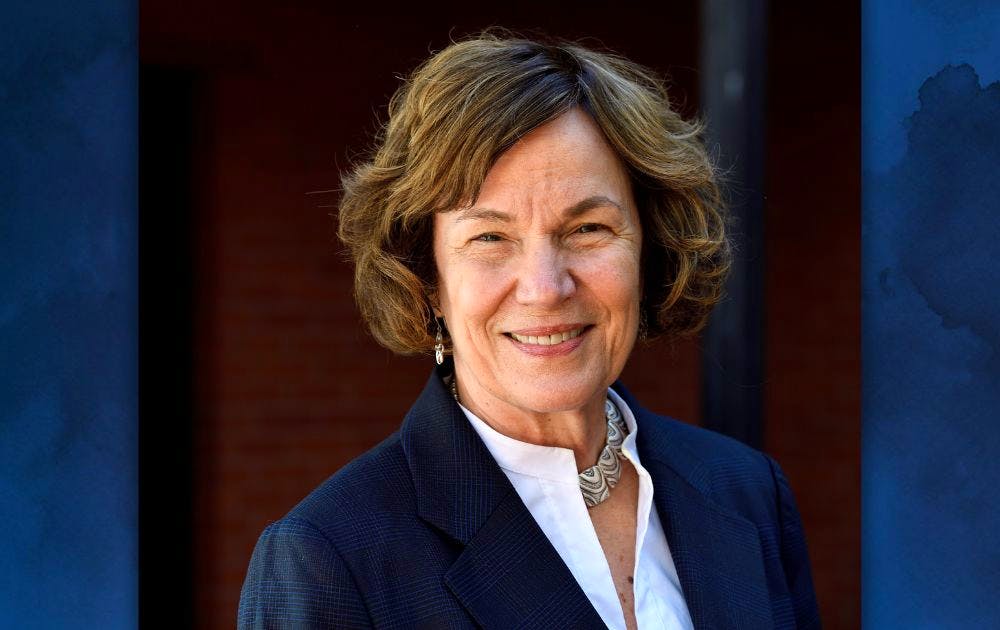
Asked how the PhD program at the University of Rochester helped to shape her career, Jacquelyn Campbell ’86N (PhD), now a professor at Johns Hopkins University and a nationally recognized researcher in intimate partner violence (IPV), recalls being “scared half to death of the gentleman who used to teach us statistics.” Statistics was not her strong point going in, she said, “but he (Dr. Thomas Knapp) taught us well, and he made sure we learned it.”
The rigor of the Rochester program, where PhD candidates submitted for a pre-doctorate fellowship from the National Institutes of Health (NIH) in the second semester, set in motion a career focus she has pursued relentlessly ever since.
“I didn’t know anything about writing a grant,” she said, “but that was part of our PhD programming.” Her research topic, involving mental and physical responses of women to abuse, received a perfect score. The NIH-funded study, her dissertation research, became one of the first of 350 peer-review papers she would publish and began a career with honors and awards that span three decades and two pages on her CV.
Campbell has contributed volumes of important research on risk factors for domestic homicide, or intimate partner homicide. Much of her work today involves training in, or showing people how to use, the Danger Assessment, a research-based instrument for assessing risk of serious injury or homicide from IPV that she developed. Available on the Johns Hopkins University website, the assessment is being used nationally and in several foreign countries. The full version and its shorter versions are currently being used at the U.S. Department of Veterans Affairs, by law enforcement in some 30 states and in domestic violence or IPV advocacy programs, among other places.
As a professor at JHU Nursing teaching research and policy related work, she has served as a mentor for dozens of PhD students and currently co-advises students in her area of research. She credits the late Carole Anderson — a former University of Rochester School of Nursing professor and associate dean who specialized in psychiatric mental health — with helping her cultivate her career.
“She didn’t have direct expertise in intimate partner violence,” she said. “Not many nurses were in that space, but she certainly guided me well . . . and that’s one thing I will be forever thankful for.”
With the students she advises, Campbell emulates the approach that Anderson took with her. “You don’t have to study what I study, but rather, let’s think about how to combine that general area of violence against women. What are the health outcomes of experiencing violence? Because that was my sweet spot. And I think that’s nursing’s sweet spot.”
One finding in Campbell’s research in particular drives her passion to improve risk assessment for intimate partner violence in healthcare institutions.
“What makes me know that we in nursing need to do better . . . is that 47% of the women in my study of intimate partner homicide were in the healthcare system somewhere in the year before they were killed. Some of them were in the ED, but they also were in primary care; they were in prenatal care; they were in mental health care.”
Campbell believes the holistic view that nurses are trained to take puts them in a position to assess when the patient is at risk. The Danger Assessment, she says is “very much in keeping with the nursing approach. It’s to help her (the victim of domestic violence) see for herself what the risk of homicide is in her relationship, so she can use that information as she makes decisions about what to do next.”
In addition to her research and work with the Danger Assessment, Campbell also makes an impact through the mentoring of nursing leaders in a variety of settings. She was the national program director for the Robert Wood Johnson Foundation Nurse Faculty Scholars program, where she mentored “in a systematic way.”
She was instrumental in helping the Nurse Family Partnership, a program in which nurses make home visits to pregnant women through the infants’ first and preferably second year, with well documented reductions in child abuse. Nursing skills, she said, are critical to navigating care in that environment.
“You have a curriculum that you follow. But if you walk into the house and mom is really upset because she can't pay the rent, then a nurse pivots. ‘All right, we need to work on this rent issue. We can do breastfeeding another time.’ Nurses have the skills to be able to address mental health problems as well as physical health problems and social problems such as IPV.”
In a recent randomized clinical trial, Campbell said, the Nurse Family Partnership protocol showed significant reductions in intimate partner violence as well as child abuse.
As a result of her long list of publications and NIH awards for research Campbell is an elected member of the National Academy of Medicine, which is rare for nurses. She attributes that accomplishment in part to the skills she learned at Rochester for getting research funding. Currently, and into the future, she looks forward to completing her service on a committee with the academy that’s focused on sexual assault at sea.
“You work with others to accumulate the evidence and then write a big report that includes recommendations of how things can be changed for better outcomes.”
Q: What’s your advice for recent grads and nurses looking to enhance their careers?
“Get a PhD! Get some help and look at a couple of different schools. Reach out to somebody there in terms of getting help preparing yourself. If you need to, take a stats refresher before you go in, do it, so it’s not a stumbling block.”
In an environment where government and academic institutions are facing cuts in funding, what would you say to someone who wants to pursue a career in research?
“Around the country there is so much need for research and appreciation particularly for nurses and the nursing perspective on things. What I tell people is we didn’t used to have a National Institute of Nursing Research (NINR), and we were able to build it. And we may have to do something like that again.”
Q: What’s your fondest memory of Rochester?
“I loved living there,” Campbell said. She used to run on the canal and was fascinated by the history of downtown Rochester with Frederick Douglas and Susan B, Anthony.
“I learned a lot about that history. I actually took a course – one of my electives was women’s studies.”
She still wears her robe from the University of Rochester at graduation ceremonies. “I was given a Scholar Award for PhD graduates, and I proudly wear that as a medallion around my neck from the University of Rochester.”
Meet more University of Rochester School of Nursing alumni and find out how you can get involved in our alumni community. Subscribe to our newsletter for monthly updates and visit our Centennial website to celebrate 100 years of nursing excellence with us.
Categories: Alumni News, PhD News, Doctoral Programs News