Centennial Spotlight: Through leadership and learning, E. Kate Valcin lifts up nurses, patients
By Gianluca D'Elia
Monday, February 9, 2026
This article appears in the 100 Years Commemorative Issue of Rochester Nursing magazine.
When E. Kate Valcin, DNP, RN, NEA-BC, CCRN, CNL, FCCM, reflects on her career as a healthcare leader, critical care nurse, and educator, one of the earliest moments that confirmed her calling to care for other humans involves — amusingly — working with bugs.
As a college student, she spent a summer working at the Cornell Cooperative Extension alongside an entomologist, leading educational sessions about insects, weeds, and pesticides. She almost changed her major to agriculture, until she realized that teaching and interacting with communities were her favorite parts of the job.
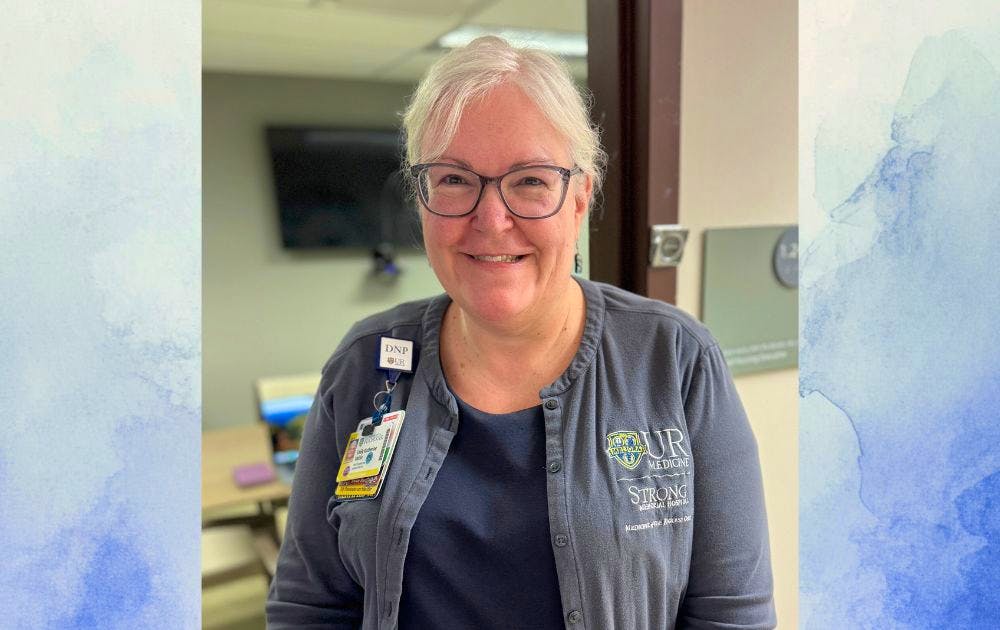
“I recognized that I could do that as a nurse — nurses are teaching all the time,” said Valcin, who went on to become the University of Rochester Medical Center’s chief nursing executive (CNE) in early 2025 and previously served as director of adult critical care nursing.
“When I was a new nurse on the oncology unit, we were teaching people about their diseases, what you needed to know when you’re about to go home after surgery, or the side effects of chemotherapy. When I got to the ICU, it was about teaching the families, because the patients often couldn't interact themselves. And then when I got into leadership, it was about teaching fellow nurses and teams, and sharing knowledge that could help our team be better.”
Throughout her career at URMC, the University of Rochester School of Nursing has helped Valcin grow in her roles as a nurse manager, director, and eventually, CNE. She earned a post-master’s Clinical Nurse Leader certificate here in 2018, and a Doctor of Nursing Practice in 2020. A learner herself not too long ago, Valcin now supports current students as the assistant dean of clinical practice as part of her CNE role, and has also taught courses and precepted for more than a decade.
“In each of my roles, the School has provided opportunities to grow professionally. I was there as a learner, but I could also guest lecture, precept, or be part of the faculty in a class,” she said. “It’s exciting to be able to keep building relationships and partnerships, and to make sure students get what they need.”
Valcin’s leadership approach and support for the School and URMC’s academic-clinical partnership are shaped by some of her earliest and most challenging career experiences. When she was struggling with burnout early in her career as a staff nurse, she reduced her hours to work part-time in her clinical role, and taught in a licensed practical nursing (LPN) program. The vocational program, which served a community hospital in Allegheny County, reignited Valcin’s passion for nursing and gave her a firsthand look at how academic-clinical partnerships functioned.
“I saw how important those programs were to each other, and how they worked together,” Valcin recalled. “When I came back to the Medical Center, began my leadership journey, and grew into my nurse manager and the director roles, I worked hard to foster similar relationships where we could help each other and grow together.”
Q: What inspired you to become a nurse educator and preceptor?
“Being a preceptor or helping teach a class is a way of giving back. Whether it’s to a particular cohort or one student, I’m paying it forward for the School that helped me,” said Valcin.
Though Valcin isn’t a full-time educator, she feels that education is part of every nursing professional’s role in different ways.
“Working with the University of Rochester School of Nursing has shown me that we all have a part to play in educating the next generation of nurses, and we all have the opportunity to step up to that in our own ways.”
One of the most rewarding parts of her role is seeing her past students’ continued impact and growth.
“Whether it’s a master’s capstone or a DNP scholarly project, the work is never all the way done,” she said. “You get things started, but they mature after graduation. In my role, I can see all of the project impact that happens well after the clinical hours are done, and that is really amazing. I love when there’s an opportunity to send an email saying, ‘Remember that project from 2 years ago? This is how it’s doing now.’”
Q: What helped you through burnout as a bedside nurse? How do you help other nurses prevent it?
An important part of addressing burnout is the first step of recognizing it and owning that you need to take a step back, Valcin said.
“I was working a lot of hours, and I was also really emotionally invested in my patients.”
By seeking support and leaning on the professional resources available to her at URMC, she found other ways to contribute to the nursing profession while taking care of herself.
“Teaching in the LPN program reconnected me to my ‘why,’” she said. “I was reminded that nursing is a powerful profession that lifts people up. There are people who have wanted to be nurses their whole lives, and they finally go back to school after their kids are done with high school, and you get to help make their dreams come true. That perspective really helped me.”
Though the experience of facing burnout was difficult, it also prepared Valcin to lead with sensitivity, and helped her weather the COVID-19 pandemic by recognizing signs of burnout early in both herself and her colleagues.
She is an advocate for work-life balance and maintaining healthy boundaries, but also tries to be aware of the mixed signals workplaces often give.
“I’m the first person to tell you not to check your email on vacation, but I’m always checking my email on vacation,” Valcin admits with a laugh. “It’s important to create an inclusive work environment where there’s space and appreciation for everyone’s style, and you can work together and say, ‘I might do things this way, but I don’t expect you to do the same.’”
Q: What advice would you share with other nurses?
“The biggest piece of advice that I try to live for myself, as well as give other people, is to show yourself grace,” Valcin said. “You don't have to be your best self every day. My best and my best today aren't the same thing. There's a tendency, sometimes, to hold yourself to an impossibly high standard, but we can’t compare ourselves to our best selves on our best day.”
Meet more University of Rochester School of Nursing alumni and find out how you can get involved in our alumni community. Subscribe to our newsletter for monthly updates and visit our Centennial website to celebrate 100 years of nursing excellence with us.
Categories: Nursing Leadership News, Alumni News, DNP News, Master's Programs News