Centennial Spotlight: Mark Lin supports cancer survivors, shines a light on lymphedema care
By Gianluca D'Elia
Monday, February 9, 2026
This article appears in the 100 Years Commemorative Issue of Rochester Nursing magazine.
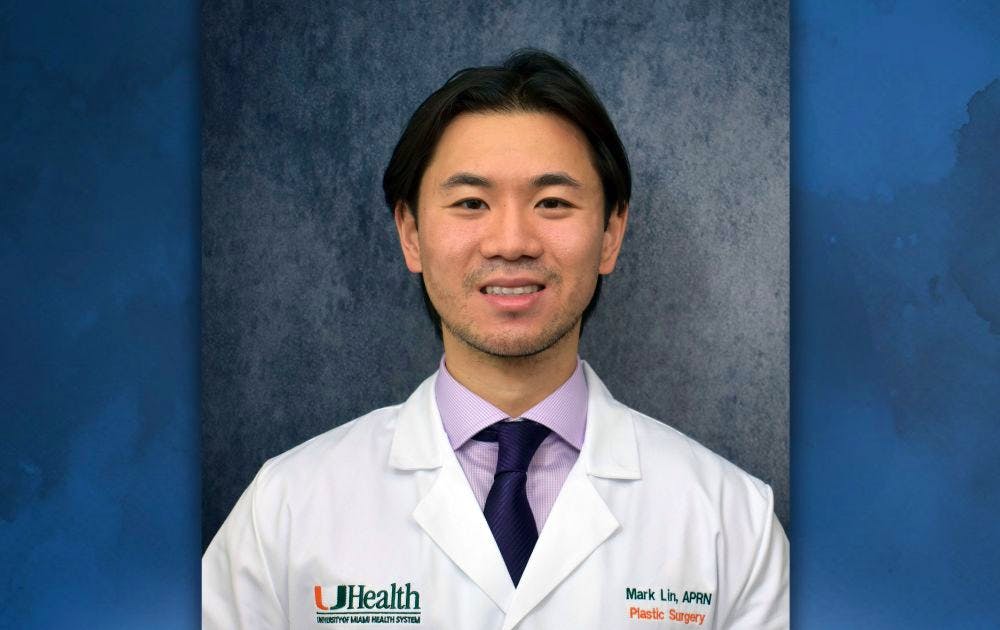
For many cancer survivors, defeating or bringing a cancer under control isn’t the end of the fight. In his role as a reconstructive surgery and lymphedema nurse practitioner, Mark Lin ’15N, APRN, aims to prepare his patients for the challenges that lie ahead.
The University of Rochester alumnus is part of a small but growing number of healthcare providers who treat lymphedema, a condition of tissue swelling that is among the most common complications of cancer treatment. His patients have often spent months and multiple medical appointments searching for answers to a condition that affects millions, but often goes unrecognized and understudied.
It’s an important part of his work as an NP for the University of Miami Health System, where he also sees breast cancer survivors who have undergone mastectomies and reconstructive surgeries.
Treatment options for the chronic disorder are limited, and there’s currently no cure — making nurses’ role in early prevention and patient education especially important.
“When you receive a cancer diagnosis, fighting the cancer is the number one priority. But patients should also be educated about what everything else looks like down the line. When a patient’s cancer is under control but their limbs get larger as a result of lymphedema, that can be traumatic for them to deal with too,” Lin explained.
Now a nurse for more than a decade, Lin had originally considered becoming a physician assistant, knowing he wanted to offer the most he could for patients in an autonomous role. But eventually, after researching advanced nursing roles such as NPs and nurse anesthetists, he found his way to the University of Rochester School of Nursing’s 12-Month Accelerated Bachelor’s program.
His experience in Rochester expanded his curiosity and prepared him to work in a variety of settings, from the emergency room to post-anesthesia care, and set him up for success in advanced practice.
“The University of Rochester set a solid foundation for me,” Lin said. “Working in a Level I Trauma Center and being able to complete our clinicals at Strong Memorial Hospital was important to me, and it helped me transition into my first job as an emergency room nurse at Duke.”
Q: How do you make an impact through your work?
“On the cancer side, I get to follow patients throughout the process of getting a mastectomy, undergoing reconstructive surgery and getting tissue expanders to reconstruct the breast, and returning for a second surgery for permanent implants,” Lin said.
That process can take as long as a year, and Lin enjoys being a constant for his patients throughout that time. For those who are at risk for lymphedema or start to develop it, he continues seeing them every three to six months to monitor their condition.
“It’s very fulfilling to me to specialize in the lymphedema field. Down the line, I know this field will continue to grow, because of the prominence of both breast cancer and cancer in general. And as we start to understand lymphedema better, more people will start to be diagnosed and treated.”
Q: Who are some individuals who made an impact on you in Rochester?
Lin considers Associate Professor of Clinical Nursing Patrick Hopkins, DNP, APRN, C-PNP, NNP, one of the most influential nurses in his life. He also credits Floyd Hutchinson ’10N, ’13N (MS), his clinical preceptor for psychiatric nursing, for inspiring him to keep an open mind to opportunities in specialties he hadn’t initially considered.
“He opened my eyes to a field of nursing I never thought I’d be interested in. Later on, when I graduated, one of the first jobs I applied to was a behavioral health nurse position — primarily because of him,” Lin recalled.
Q: What advice would you share with early-career nurses?
“The biggest thing is to keep your mind open, especially regarding what kind of job you would take,” Lin said. “Prior to taking the position I have now, I was searching for jobs after NP school and ended up working as a nurse in the University of Miami Recovery Room. I saw hundreds of different surgeons a day who I still talk to now. Sometimes, it’s all about the people you meet: if I didn’t work that job, I wouldn’t have the job that I’m working in now. The recovery room where I once worked is also helping me get certified to do minor procedures on my own, so the nurses there will be helping my patients recover.”
Lin also emphasized the importance of self-care for nurses.
“We always put patients in front of ourselves, but you also have to take a step back. In my first year as a nurse, I burned myself out because I wasn’t caring for myself. Now, I have more time compared to when I was working 12-hour shifts. I try to be more conscious about what I eat, stay active, and go out on walks with my wife and our dog."
Q: What do you look forward to in the future as you continue your NP career?
Lin looks forward to being part of advances in the field over the next decade, especially in lymphatic reconstruction.
“There's still a lot about lymphedema that isn’t fully understood, and there are surgical options, but not many people that are trained to perform them. There’s still a lot of room to teach nurses and physicians more about what lymphedema is, and how we can manage and prevent it. I'm looking forward to continuing in this specialty. I know it’s something not every hospital has – it’s something unique that I can offer.”
Meet more University of Rochester School of Nursing alumni and find out how you can get involved in our alumni community. Subscribe to our newsletter for monthly updates and visit our Centennial website to celebrate 100 years of nursing excellence with us.
Categories: Accelerated Programs News, Alumni News