The power of precepting: Rural clinical rotation shapes future NP's career, confidence
By Scott Norris
Thursday, July 16, 2026
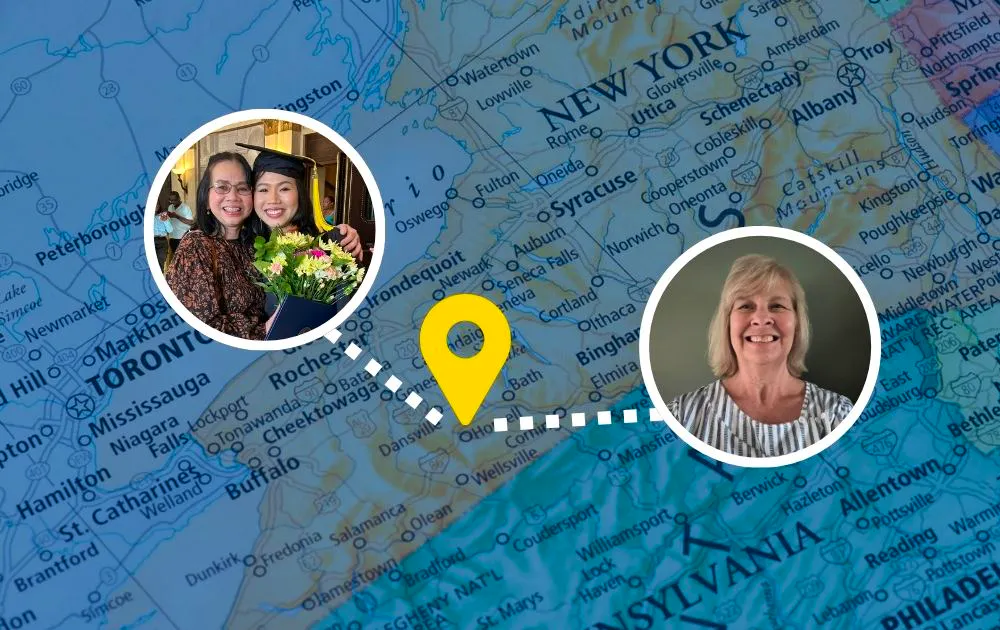
Ngoc Pham ’22N, ’25N (MS), recalls being in a “rough place mentally” in the final semester of her master’s to become a Family Nurse Practitioner (FNP). “There was a lot of stress and a lot going in in my life,” she said.
She was awaiting her clinical placements, which she hoped would be in cardiac or surgery, areas she thought most relevant to her career goals. Instead, she was assigned to orthopedics and primary care. Her primary care assignment was also an hour-and-a-half away in Hornell, near St. James Hospital, and she was concerned about long winter drives.
All that worry went away on the first day with her preceptor, Kimberley Betker, NP, who practices at Hornell Primary Care. The experience completely changed Pham’s outlook.
“I felt nothing but welcomed,” Pham said. “I felt a sense of belonging. The way she presented herself, how confident she was, how much she cared about her patients — it made me feel assured that I was going to have a good semester and learn a lot. And that's exactly what happened.”
The disappointment Pham felt in not getting her preferred placement gave way to an understanding that the Hornell rotation exposed her to a breadth of experiences she would not find in other healthcare settings. It challenged her to develop patient care skills she could not learn in the classroom. And in Betker, she knew she had an ideal role model.
Betker’s day offers a master class in time management. At 7:40 a.m., she sees the first of the 20 to 25 patients scheduled every 20 minutes for the day. She conducts physicals for the New York State Department of Transportation at the beginning and end of every day, saving patients who require clearance to drive a commercial truck from having to travel to the city. She relies on the other scheduled physicals, which get a 40-minute slot but sometimes take less time, to make room for same-day visits for conditions like sore throats or earaches that can be handled in about 10 minutes. She takes lunch from 1-2 p.m., when she catches up on prescription refills, reviewing messages from specialists, notifying patients about the results of blood work and responding to MyChart messages from patients.
Asked how the delivery of primary care is different for NPs in a rural setting, Betker cites the broad scope of responsibility. With a physician shortage in the area, the NP manages a panel of 1,200 patients. Although her physician colleage, Adrian Ashdown, MD, is in the office and available for questions, Betker manages her daily patient load independently.
With limited access and long waits to see specialists, she ensures patients receive appropriate testing before their appointments. She performs triage by documenting patient history and using e-consults to communicate with specialists, then orders and manages the treatment plan.
The depth of Betker’s rural practice exposed Pham to a broad range of conditions and complexities in patient care that serve her well as a Family Nurse Practitioner (FNP). Among other things, she learned more than she expected about psych, anxiety medications, women’s health and managing diabetes and hypertension.
“In school, they teach you that if a patient is on two or more blood pressure medications, it's an automatic referral to a specialist — but Kim managed all those medications herself, and she did it so well. I also didn't realize how complex diabetes could be until I saw it firsthand in that patient population.”
But perhaps more than clinical knowledge, what Pham valued most was learning from Betker’s approach to patients.
“Kim was very personal with patients, but also very straight to the point. That combination of directness and compassion matched really well with my own personality and how I am with my patients. She was such a good role model.”
Betker has students shadow her on the first day. On the second day, they perform a patient assessment and present the patient’s history, objective findings, suspected diagnosis, and a treatment plan. Betker always sees the patient herself, but once students develop competence in presenting, they begin to write patient charts.
“The idea,” Betker said, “is that if they learn to present a patient well, the documentation follows naturally.”
In the beginning, precepting requires an investment in the student, Betker said. Teaching takes time and some work gets pushed into the lunch hour or taken home. But after the student progresses and begins documenting patients, it can save time because Betker can simply review and sign the notes rather than writing them from scratch.
The experience of learning to assess a broad spectrum of patients proved invaluable to Pham, who now practices in the Children’s Heart Center at Golisano Children’s Hospital.
“Kim and I developed a very trusting relationship early on. She let me be open about things I wasn't sure about, and we would talk through them together. Even with her schedule being so tight, she still spent time walking me through issues I didn't understand.”
Throughout her 30-year career as an NP, Betker has taken in students almost every semester.
“I like to feel that I'm not here just for a paycheck, that I make a difference in people's lives,” she said. “If I can teach and give back, it's another way to make a difference. You know, she [Ngoc] touched my life, and I hope I touched her life as well. And hopefully she’ll pass that forward and teach as well.”
Want to help shape New York’s next generation of nurse practitioners? Visit urson.us/preceptors to learn more about becoming a preceptor.
Categories: Clinical Experience News, Nurse Practitioner Programs News